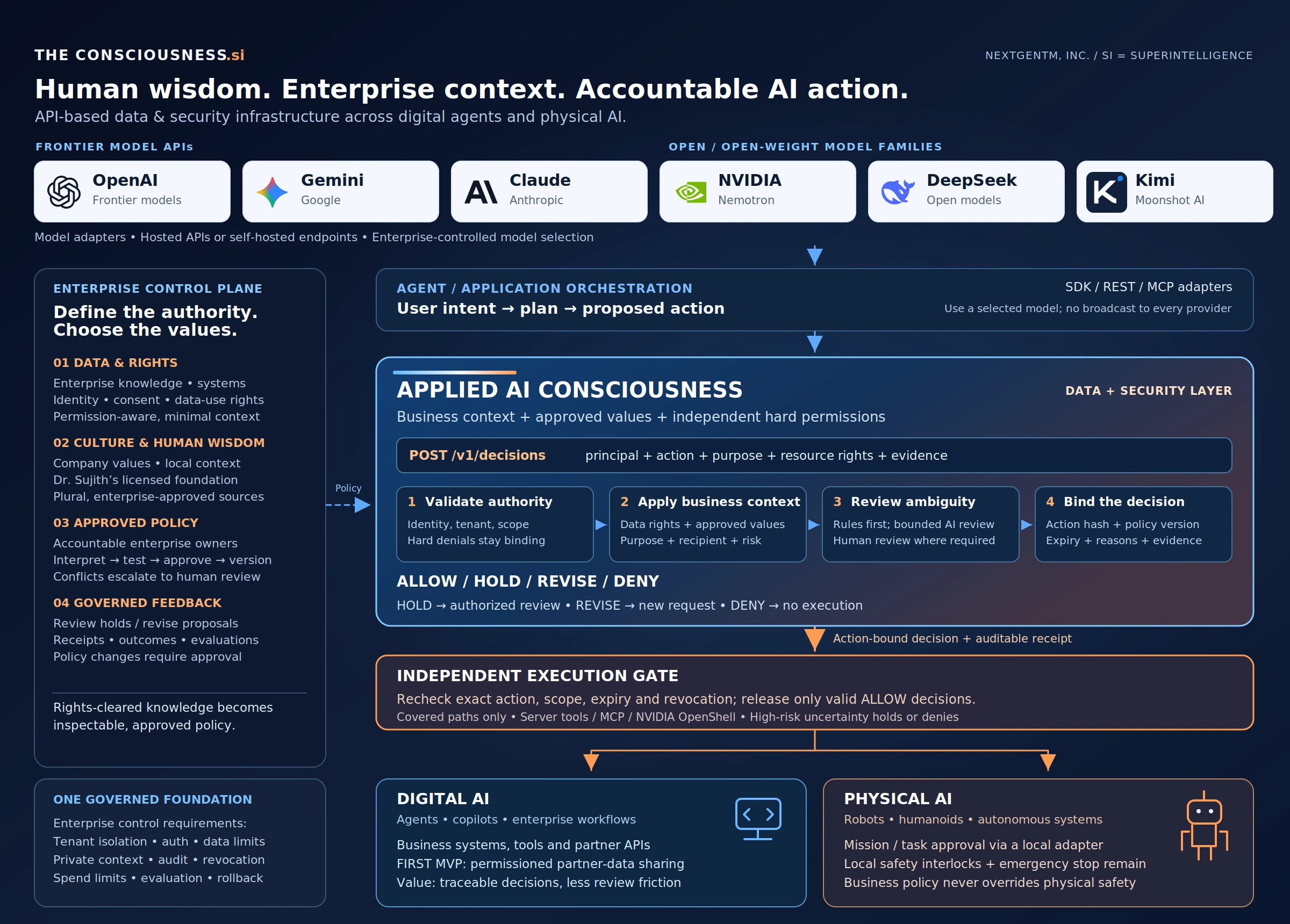
01 / BUSINESS ARCHITECTUREHuman sources. Accountable owners.
Enterprise data and usage rights + company/cultural values + licensed human wisdom → accountable owners interpret, test and approve versioned policies → contextual decisions → traceable permitted actions.
Dr. Sujith’s licensed corpus is a founding source. Additional plural enterprise-approved frameworks can follow. Cultural context is explicitly approved, never inferred from a person’s demographics.
No universal morality or guaranteed moral correctness is implied. Guru approval cannot override law or hard permissions.
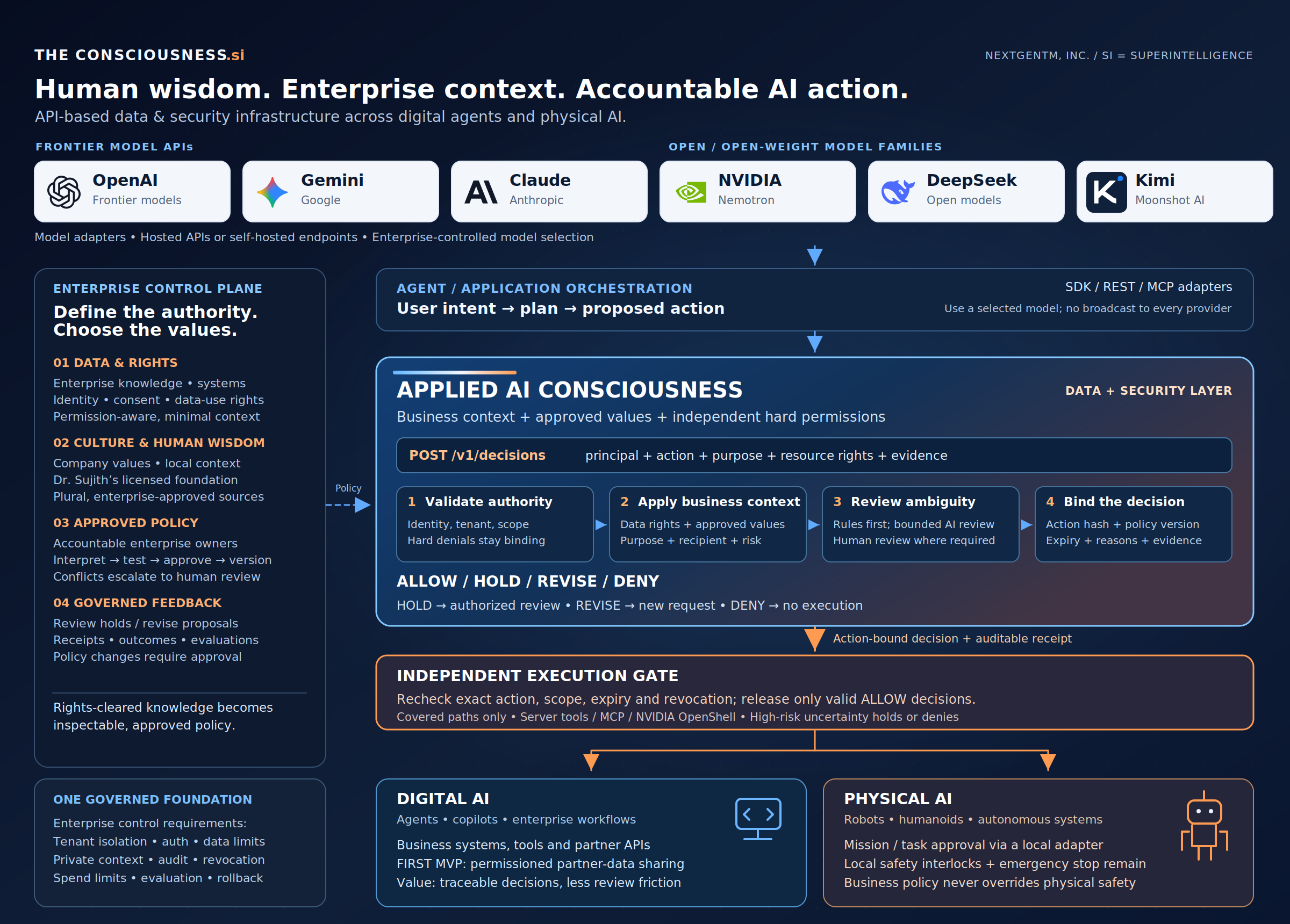
02 / TECHNICAL ARCHITECTUREReview the proposal. Bind the decision.
An agent/app proposes an action. The Decision API contract, POST /v1/decisions, normalizes principal, action, purpose, resource_refs, policy_version and evidence. Hard permissions come first, followed by permission-aware minimal retrieval, bounded contextual review only for ambiguity and authorized human review where required.
Return allow / hold / revise / deny with reasons, evidence refs, action hash, policy version, expiry and audit ID. A separate customer/runtime gate must authenticate the decision, bind it to the exact action, principal, resource and scope, reject replay, expiry, revocation or changed parameters, and execute only a valid allow.
Hold awaits authorized review; revise requires a new checked request; deny executes nothing.
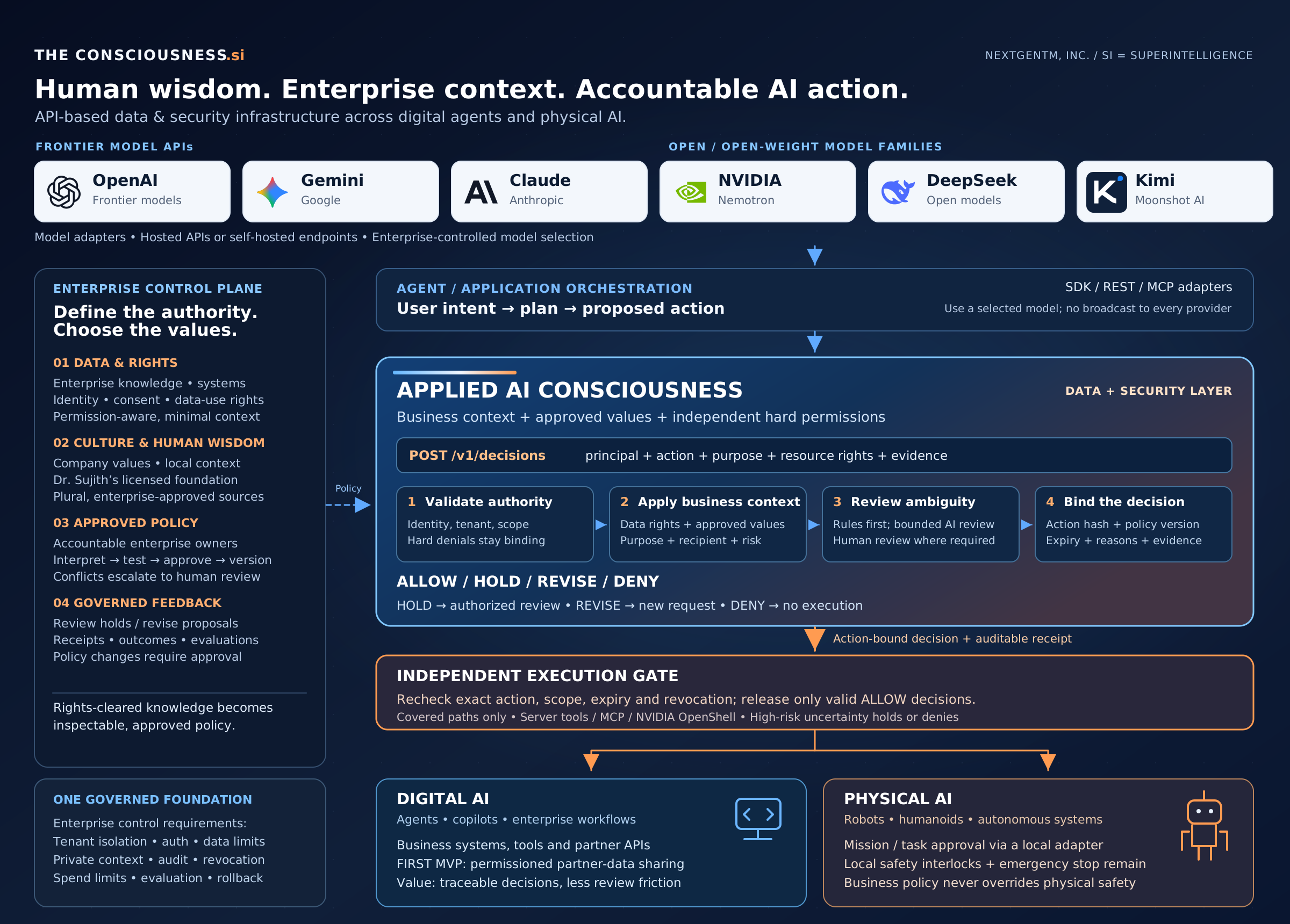
03 / SHARED FOUNDATION, DISTINCT EXECUTIONDigital boundaries. Local physical safety.
Digital agents use a controlled server-side tool/export/send boundary. The first wedge remains partner-data sharing. Physical AI uses bounded mission/task authorization via a local adapter.
Real-time motion, collision controls, safety interlocks and emergency stop remain local and authoritative—not dependent on cloud model inference. Revocation and offline behavior must be specified and tested; protection does not extend universally beyond integrated paths.
Feedback enters governed evaluation. It does not autonomously change approved policy.